Table of Contents
Artificial intelligence is no longer competing on capability alone it is competing on reasoning, creativity, productivity, and trust.
The artificial intelligence industry is evolving at an unprecedented pace. What started as experimental chatbot technology has now transformed into a global competition between some of the world’s most powerful AI systems. Businesses, creators, developers, and everyday users are increasingly relying on AI not only for answers but also for writing, coding, research, decision-making, and productivity.
At the center of this transformation are three dominant players: Google Gemini, ChatGPT, and Claude AI. The growing discussion around Gemini vs ChatGPT vs Claude AI has become one of the biggest trends in the technology industry because these platforms represent different visions of how artificial intelligence should evolve. While all three systems are powered by advanced large language models, their strengths, priorities, and user experiences vary significantly.
Some focus heavily on real-time information and ecosystem integration, while others prioritize conversational depth, reasoning ability, or enterprise productivity. As competition intensifies, the battle between Gemini, ChatGPT, and Claude AI is shaping the future of digital work, search, content creation, and intelligent automation.
Understanding the differences between these platforms is important not only for technology enthusiasts but also for businesses and professionals trying to identify which AI system best aligns with their needs.
Understanding the Rise of AI Assistants
The popularity of AI assistants has increased rapidly because users are no longer looking for simple automation tools. Modern users expect AI systems to think, analyze, summarize, generate, and assist in real time. Earlier generations of AI tools were designed primarily for narrow tasks such as answering predefined questions or automating repetitive processes. Today’s systems operate very differently.
Modern AI assistants can generate human-like responses, write code, summarize documents, analyze data, assist with research, and even perform creative tasks. This shift has transformed AI from a support technology into a central productivity layer across industries.
The rapid growth of generative AI has also changed user expectations. People increasingly want conversational systems capable of understanding intent and maintaining context rather than simply responding to isolated prompts. This evolution is exactly why the conversation around Gemini vs ChatGPT vs Claude AI has become so important.
These platforms are no longer just chatbots—they are becoming digital collaborators.
How This Competition Is Reshaping the AI Industry
The competition surrounding Gemini vs ChatGPT vs Claude AI is accelerating innovation across the entire artificial intelligence ecosystem. Each company is investing heavily in improving model intelligence, multimodal capabilities, reasoning performance, productivity integration, and enterprise adoption.
This competition is also influencing how businesses approach AI adoption. Organizations are no longer asking whether they should use AI they are asking which AI platform best fits their workflows, infrastructure, and strategic goals.
The AI race is also reshaping industries such as search, education, customer service, software development, marketing, and enterprise productivity. As these systems continue to improve, they are becoming central operational layers within digital ecosystems.
ChatGPT: The AI System That Mainstreamed Generative AI
When discussing Gemini vs ChatGPT vs Claude AI, it is impossible to ignore the impact ChatGPT had on the global AI landscape. Developed by OpenAI, ChatGPT played a major role in bringing generative AI into mainstream adoption. Its conversational capabilities, accessibility, and ability to handle a wide range of tasks made AI usable for millions of people worldwide.
One of ChatGPT’s biggest strengths lies in versatility. It performs well across multiple use cases including writing, brainstorming, coding, summarization, research assistance, and conversational interaction. The platform is also widely recognized for its intuitive interface and strong creative capabilities.
Another important factor in ChatGPT’s growth is ecosystem expansion. OpenAI has continuously integrated new capabilities such as multimodal interaction, memory systems, and advanced productivity tools, making ChatGPT more than just a standalone chatbot.
In the broader discussion around Gemini vs ChatGPT vs Claude AI, ChatGPT is often viewed as the most balanced and widely adopted platform, particularly for creators, professionals, and businesses looking for flexibility.
Gemini: Google’s Vision for AI-Powered Search and Productivity
Google Gemini represents Google’s broader vision for integrating artificial intelligence across search, productivity, and ecosystem experiences. Unlike traditional standalone AI systems, Gemini is deeply connected to Google’s infrastructure. This gives it a major advantage in areas such as real-time information access, web integration, and productivity workflows.
One of the most important aspects of Gemini is its multimodal capability. Google has focused heavily on enabling Gemini to process text, images, documents, videos, and other forms of information together.
This creates a more context-rich experience where users can interact with different types of content seamlessly.
Another major advantage in the Gemini vs ChatGPT vs Claude AI comparison is Google’s ecosystem integration. Gemini connects naturally with tools such as Gmail, Docs, Sheets, Drive, and Search, making it highly useful for users already operating within the Google ecosystem.
Google is also positioning Gemini as a major force in AI-powered search. Instead of simply displaying links, Gemini aims to generate contextual answers, summaries, and intelligent recommendations directly within search experiences. This shift has significant implications for how users discover and interact with information online.
Claude AI: The Rise of Contextual and Reasoning-Focused AI
Claude AI by Anthropic has emerged as one of the strongest competitors in the generative AI race, particularly in areas related to reasoning, long-context understanding, and enterprise-focused workflows.
Unlike platforms heavily optimized for speed or ecosystem integration, Claude AI has developed a reputation for thoughtful responses, strong contextual comprehension, and nuanced reasoning capabilities. One of Claude AI’s biggest strengths is its ability to process extremely large amounts of context. This makes it particularly valuable for tasks involving long documents, research analysis, strategic planning, and complex workflows.
In discussions around Gemini vs ChatGPT vs Claude AI, Claude is often viewed as the platform most optimized for deep reasoning and analytical tasks.
Another important aspect of Claude AI is Anthropic’s focus on AI safety and alignment. The company places significant emphasis on building systems that are reliable, transparent, and less likely to generate harmful outputs. This approach has made Claude especially attractive to enterprise users who prioritize trust, compliance, and reliability.
Comparing Gemini, ChatGPT, and Claude AI
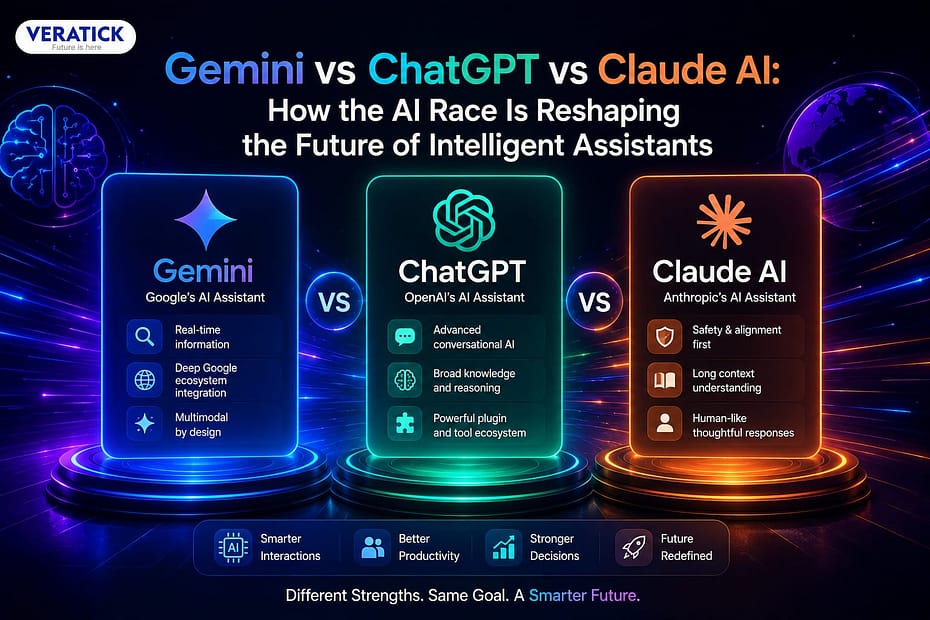
The conversation around Gemini vs ChatGPT vs Claude AI is not about identifying a single “best” platform. Instead, it reflects how different AI systems are optimized for different strengths and use cases.
ChatGPT is often recognized for versatility and mainstream usability. It performs strongly across creative tasks, coding, writing, brainstorming, and conversational interaction. Its flexibility makes it appealing to a broad audience ranging from students and creators to businesses and developers.
Gemini, on the other hand, benefits heavily from Google’s ecosystem and infrastructure. Its integration with real-time web information and productivity tools makes it especially useful for users already relying on Google services. Claude AI distinguishes itself through contextual understanding, reasoning depth, and long-document processing. It is particularly valuable for enterprise environments, research workflows, and analytical tasks requiring nuanced interpretation.
The growing importance of Gemini vs ChatGPT vs Claude AI reflects a broader trend within the AI industry: specialization. Rather than one AI system dominating every use case, different platforms are evolving around distinct strengths and strategic priorities.
The Future of AI Assistants
The future of Gemini vs ChatGPT vs Claude AI points toward increasingly intelligent and proactive systems. AI assistants are expected to evolve beyond conversational tools into autonomous digital collaborators capable of managing workflows, analyzing information, and completing tasks independently.
Multimodal interaction will also become increasingly important. Future systems will combine text, voice, images, video, and real-time contextual understanding into unified experiences.
Another major shift will involve deeper personalization. AI systems will adapt dynamically to individual preferences, work habits, and communication styles, creating more tailored experiences. As these technologies mature, the distinction between search engines, productivity tools, and AI assistants may gradually disappear altogether.
Conclusion
The growing competition between Gemini, ChatGPT, and Claude AI represents far more than a technology race it reflects the rapid transformation of how humans interact with information, productivity, and digital systems.
Each platform brings unique strengths to the evolving AI ecosystem. ChatGPT emphasizes versatility and accessibility, Gemini focuses on ecosystem integration and real-time intelligence, while Claude AI prioritizes reasoning depth and contextual understanding.
The broader discussion around Gemini vs ChatGPT vs Claude AI highlights a critical reality: artificial intelligence is no longer a futuristic concept it is becoming a foundational layer of modern digital life. As these systems continue to evolve, they will redefine how people work, learn, search, create, and make decisions in the years ahead.
The future of AI will not be defined by a single model, but by how intelligently these systems integrate into human workflows. At VERATICK, we explore innovations like Gemini vs ChatGPT vs Claude AI that are shaping the next generation of digital intelligence!