Table of Contents
Search is no longer about finding links it’s about getting answers, insights, and decisions instantly!
The internet has always depended on search engines to organize and deliver information. For decades, users relied on traditional search systems to browse the web, compare sources, and manually identify relevant information. This model shaped the digital world and became the foundation of how people interacted with online content.
However, the search experience is now undergoing one of the biggest transformations in internet history. The rise of generative artificial intelligence is changing how users discover and consume information online. Instead of displaying pages filled with blue links, modern AI-powered systems are beginning to provide direct answers, contextual explanations, summaries, and conversational responses.
At the center of this transformation is the rapid growth of AI search engines. Unlike traditional search platforms that primarily index and rank websites, AI search engines are designed to understand user intent, interpret context, and generate intelligent responses in real time. This represents a major shift from keyword-based discovery to conversational and intent-driven interaction.
The emergence of platforms such as Google’s AI Overviews, Perplexity AI, ChatGPT Search, and Microsoft Copilot demonstrates how quickly this evolution is accelerating. Search is no longer limited to navigation it is becoming a system for understanding, reasoning, and assisting users directly.
As businesses, marketers, and consumers adapt to this new environment, AI search engines are becoming one of the most important technological trends shaping the future of the internet.
Understanding AI Search Engines
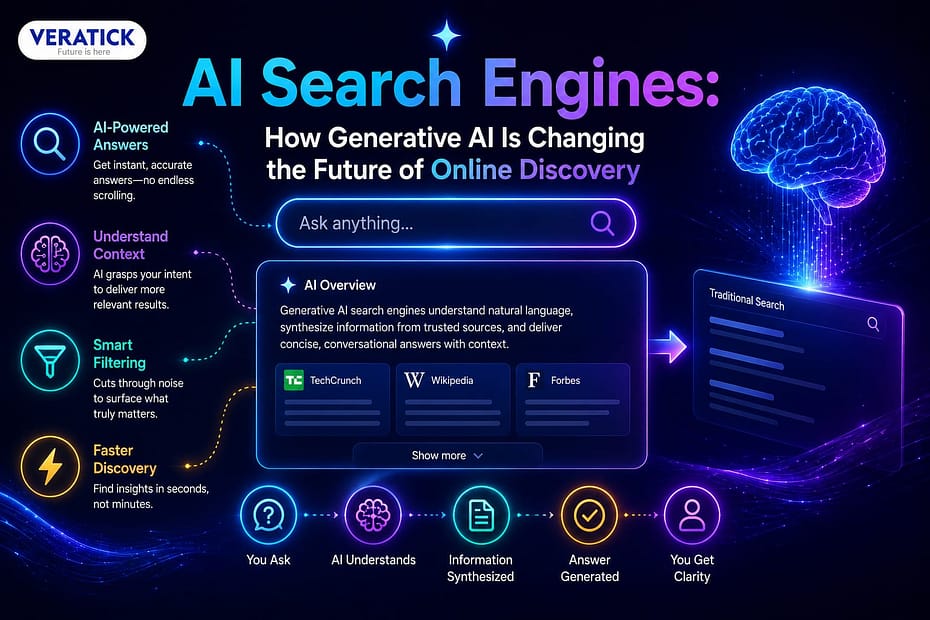
At a fundamental level, AI search engines are search systems powered by generative artificial intelligence and natural language processing technologies. Unlike traditional search engines that primarily retrieve indexed web pages, AI search engines analyze information from multiple sources and generate contextual responses for users.
This distinction is important because it changes the entire structure of online discovery. Traditional search engines rely heavily on keywords and ranking algorithms. Users type a query, receive a list of links, and manually browse through websites to find answers. The responsibility of interpreting and comparing information remains with the user.
AI search engines operate differently. Instead of simply matching keywords, they attempt to understand the meaning and intent behind a query. They process information across multiple sources and provide direct responses in conversational form.
For example, instead of searching: “Best smartphone under ₹30,000.” Users can ask: “I need a smartphone with strong battery life, a good camera for travel photography, and smooth gaming performance.” The AI system interprets the broader context and delivers recommendations based on actual user needs rather than isolated keywords. It creates a more intuitive and human-like search experience.
Why AI Search Engines Are Growing Rapidly
The rapid rise of AI search engines is closely connected to changing user behavior and expectations. Modern internet users value speed, convenience, and clarity. Traditional search often requires users to open multiple tabs, compare articles, evaluate credibility, and manually synthesize information. While effective, this process can be time-consuming and mentally exhausting.
AI search engines simplify this experience by acting as intelligent intermediaries between users and information. Instead of forcing users to perform research manually, these systems analyze content, summarize insights, and present concise answers instantly. This dramatically reduces the time required to gather information and make decisions.
Another reason behind the popularity of AI search engines is the growing preference for conversational interaction. Users increasingly expect digital systems to behave more like assistants rather than static tools. The success of conversational AI platforms has accelerated this expectation. As people become comfortable interacting with AI through natural language, conversational search is becoming a natural extension of online behavior.
How AI Search Engines Are Changing Online Discovery
One of the most transformative aspects of AI search engines is the way they are reshaping online discovery itself. Traditional search systems were designed primarily for navigation. Their role was to direct users toward relevant websites. Success depended heavily on ranking positions and click-through rates.
AI search engines are shifting this model toward direct information delivery. Instead of acting only as gateways to websites, these systems increasingly function as information destinations themselves. Users often receive complete answers without needing to visit external pages. This shift is creating what many experts describe as the rise of “zero-click search.”
In zero-click experiences, users ask a question, receive a summarized answer generated by AI, and move on without opening additional links. While this improves convenience for users, it also creates major implications for publishers, marketers, and businesses that depend on website traffic. The focus of digital visibility is beginning to shift from ranking for clicks to becoming part of AI-generated responses.
Conversational Search Is Replacing Keyword Search
Another major development driven by AI search engines is the transition from keyword-based interaction to conversational search. Traditional search engines often require users to phrase queries in simplified formats optimized for algorithms. This led to unnatural search behavior where users typed fragmented keywords instead of complete thoughts.
AI-powered search changes this entirely. Users can now ask detailed and nuanced questions conversationally, just as they would speak to another person. AI systems interpret context, intent, and follow-up questions naturally.
This creates a much smoother interaction experience and significantly reduces friction during the search process. Conversational search also allows users to explore topics more deeply. Instead of repeatedly reformulating queries, users can continue a dialogue with the AI system, refining their questions and receiving increasingly tailored responses. This fundamentally changes how people interact with information online.
The Impact of AI Search Engines on SEO
The rise of AI search engines is creating major changes in the world of SEO and digital marketing. For years, SEO strategies focused heavily on optimizing websites for keyword rankings and clicks. Businesses competed to appear on the first page of search results because visibility directly influenced traffic and revenue.
However, AI-generated answers are beginning to disrupt this model. As users increasingly receive direct responses without visiting websites, businesses may experience declining organic traffic even when their content contributes to AI-generated summaries.
This means that SEO strategies must evolve. Instead of focusing only on ranking positions, businesses now need to optimize content for AI discoverability and contextual relevance. High-quality, authoritative, and well-structured content becomes even more important because AI systems prioritize information that is clear, trustworthy, and contextually valuable.
The role of branding is also becoming more significant. As AI search engines summarize information from multiple sources, strong brand authority increases the likelihood of being referenced within generated responses.
AI Search Engines and E-commerce
The influence of AI search engines extends far beyond information discovery it is also transforming digital commerce. Consumers increasingly use AI systems to compare products, evaluate reviews, and receive personalized recommendations. Instead of browsing multiple websites manually, users can ask AI systems to identify the best options based on specific preferences and needs.
This creates a more efficient and personalized shopping experience. AI search engines are also accelerating the growth of conversational commerce, where interactions happen through dialogue rather than traditional browsing interfaces. As these systems become more integrated into shopping ecosystems, the distinction between search engines and digital assistants will continue to blur.
Challenges Facing AI Search Engines
Despite their advantages, AI search engines also introduce several important challenges. One major concern is accuracy. Generative AI systems can occasionally produce incomplete, outdated, or incorrect information. Because responses are presented confidently and conversationally, users may trust inaccurate outputs without verification.
Another challenge is transparency. Traditional search engines provide users with multiple sources, allowing them to evaluate information independently. AI-generated summaries, however, can obscure source diversity and reduce visibility into how conclusions are formed.
Privacy is another critical issue. AI search engines rely heavily on analyzing user behavior and contextual data to personalize experiences. This raises concerns around data collection, consent, and user security. Businesses and technology providers will need to address these concerns carefully as adoption continues to grow.
The Future of AI Search Engines
The future of AI search engines points toward increasingly intelligent, proactive, and integrated systems. Future AI-powered search experiences are expected to become deeply personalized, adapting dynamically to individual preferences, behavior, and context. Instead of reacting only to queries, AI systems may proactively suggest information, recommendations, or actions before users even ask.
Voice interaction and multimodal search will also play a larger role. Users may increasingly interact with AI systems through voice, images, videos, and other formats rather than text alone.
AI search engines are also expected to integrate more deeply with productivity tools, e-commerce platforms, and enterprise systems. This will transform search from a standalone activity into an embedded layer across digital experiences.
As these technologies continue evolving, the internet itself may become less about navigating websites and more about interacting with intelligent systems capable of understanding and assisting users directly.
Conclusion
The rise of AI search engines represents one of the most significant transformations in the history of the internet. Search is evolving from a system built around keywords and links into a conversational, intelligent, and context-aware experience. Users are no longer satisfied with simply finding information they expect systems to understand it, summarize it, and help them act on it instantly.
For businesses, marketers, and content creators, this shift creates both opportunities and challenges. Success will increasingly depend on creating authoritative, valuable, and AI-friendly content capable of standing out in a rapidly changing digital ecosystem.
As artificial intelligence continues to reshape online discovery, AI search engines are set to redefine how people interact with the internet itself.
The future of search is no longer about navigating information it’s about understanding it instantly. At VERATICK, we explore how innovations like AI search engines are transforming the next generation of digital experiences!