Table of Contents
Online shopping is no longer evolving around clicks and catalogs it is evolving around intelligence, prediction, and autonomous experiences!
The e-commerce industry is entering one of the most transformative phases in its history. For years, online shopping revolved around websites, search bars, and recommendation engines that required users to manually browse products, compare prices, and make purchasing decisions independently. While artificial intelligence has already improved digital commerce through personalization and automation, a much larger shift is now taking place.
The rise of AI agents in e-commerce is changing the way consumers interact with online stores entirely. Instead of functioning as passive assistants that only respond to commands, AI agents are becoming intelligent systems capable of making decisions, understanding preferences, managing workflows, and even completing transactions autonomously. This transformation is pushing digital commerce beyond simple automation and into an era of intelligent shopping experiences.
Major technology companies are already investing heavily in this direction. AI-powered shopping assistants, conversational search systems, and autonomous recommendation engines are rapidly becoming part of mainstream digital ecosystems. Consumers are beginning to rely less on traditional browsing and more on intelligent systems capable of simplifying the entire purchasing journey.
As expectations for speed, convenience, and personalization continue to rise, AI agents in e-commerce are becoming one of the most important innovations shaping the future of online retail.
Understanding the Rise of AI Agents in E-commerce
At a fundamental level, AI agents in e-commerce are intelligent systems designed to perform shopping-related activities autonomously on behalf of users or businesses. Unlike conventional chatbots that simply respond to direct commands, AI agents are capable of understanding broader objectives and independently carrying out tasks to achieve them. This distinction represents a major evolution in artificial intelligence.
Traditional AI systems operated reactively. They answered questions, displayed recommendations, or provided support only after receiving specific instructions from users. AI agents, however, function proactively. They can continuously monitor pricing changes, evaluate inventory availability, compare competing products, analyze customer preferences, and deliver highly personalized recommendations without requiring constant human input.
For example, a customer searching for a smartphone no longer needs to manually browse dozens of websites, compare technical specifications, and monitor discounts. An AI agent can manage the entire process automatically by identifying the best options based on budget, performance requirements, design preferences, and real-time market conditions.
This transforms online shopping from a manual and time-consuming activity into an intelligent and streamlined experience.
Why Consumer Behavior Is Driving This Transformation
The rapid growth of AI agents in e-commerce is closely tied to changing consumer behavior and expectations. Modern consumers are surrounded by overwhelming amounts of information. Every product category contains thousands of listings, endless reviews, multiple price points, and competing recommendations. While digital commerce has expanded access to products, it has also made decision-making more complex.
As a result, consumers increasingly prioritize convenience and simplicity over endless browsing. This shift has created an environment where intelligent systems capable of reducing complexity become extremely valuable. AI agents simplify the decision-making process by understanding intent, filtering irrelevant information, and presenting optimized recommendations in real time.
Another important factor driving adoption is speed. Consumers increasingly expect instant responses and frictionless experiences. Long browsing sessions, delayed support, and complicated purchasing journeys create frustration in a digital environment where attention spans continue to decrease.
Businesses that fail to adapt to these changing expectations risk losing engagement and conversions. Because of this, AI agents in e-commerce are rapidly evolving from optional technological enhancements into strategic necessities.
How AI Agents in E-commerce Work
One of the most important characteristics of AI agents in e-commerce is their ability to move beyond traditional keyword-based systems. Conventional search systems rely heavily on keyword matching. This often forces users to simplify their needs into fragmented search phrases, limiting the quality and relevance of results.
AI agents function differently. Instead of merely identifying keywords, they use machine learning and natural language processing to understand context, intent, and behavioral patterns. This enables much more conversational and intuitive interactions.
The AI agent interprets the broader objective behind the request and delivers recommendations based on actual usage requirements instead of isolated keywords. This significantly improves the accuracy and relevance of product discovery.
Another defining capability of AI agents in e-commerce is their ability to adapt in real time. These systems continuously monitor pricing changes, inventory levels, customer behavior, and market trends. If a better option becomes available or a product goes out of stock, recommendations can instantly adjust. This transforms online shopping into a dynamic and continuously optimized experience.
Conversational Commerce Is Accelerating AI Adoption
The rise of conversational commerce is playing a major role in accelerating the adoption of AI agents in e-commerce. Traditional e-commerce interfaces were designed around navigation menus, product categories, and filters. While effective, these systems still require users to actively search, compare, and evaluate products manually.
Conversational commerce removes much of this friction by allowing users to interact naturally through AI-powered conversations. Instead of browsing multiple pages step by step, customers can simply describe what they need conversationally. AI agents then interpret these requests, analyze options, and guide users through the purchasing process seamlessly. This fundamentally changes the nature of digital retail.
The storefront is no longer limited to a website it becomes an intelligent conversation capable of understanding and responding dynamically to customer intent. This shift is especially important because conversational systems reduce decision fatigue. Customers no longer need to process overwhelming amounts of information independently. Instead, AI agents simplify complexity into clear and actionable recommendations, making shopping faster and more intuitive.
Autonomous Shopping Is Becoming Reality
One of the most transformative developments within AI agents in e-commerce is the emergence of autonomous shopping experiences.
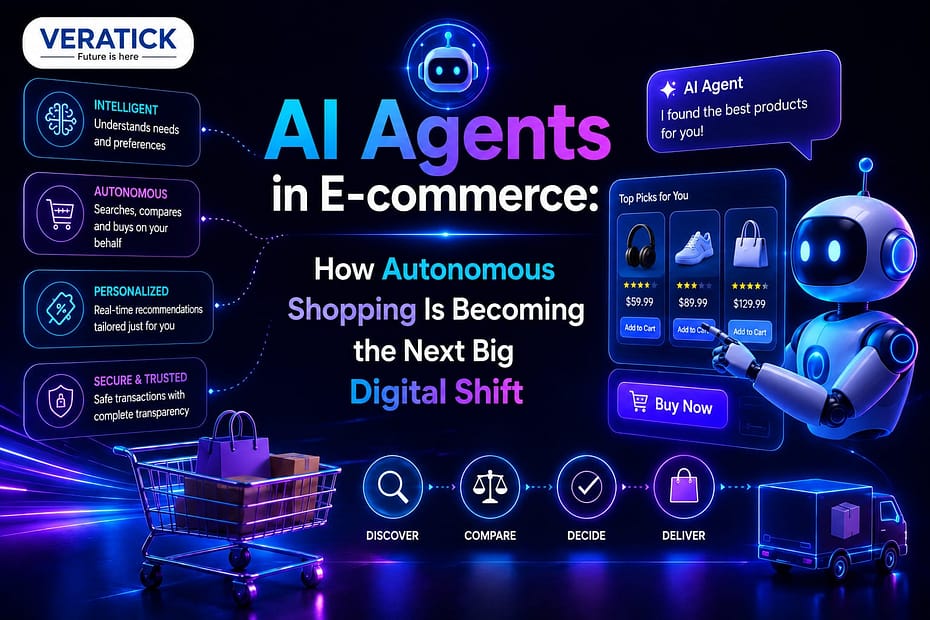
In earlier stages of AI adoption, systems primarily assisted customers while leaving all final decisions to humans. Today, AI agents are beginning to perform actions independently. These systems can monitor discounts, reorder frequently purchased products, manage subscriptions, track inventory changes, and even complete purchases automatically.
This transition from assisted commerce to autonomous commerce significantly changes the role of consumers. Rather than manually managing every stage of the buying process, users increasingly act as supervisors who review or approve AI-generated decisions while the system handles operational complexity in the background.
This creates a much more efficient and frictionless shopping experience, particularly for recurring or low-risk purchases. As these technologies continue evolving, autonomous shopping may eventually become a standard feature across major digital commerce platforms.
Hyper-Personalization Through AI Agents
Personalization has existed in e-commerce for years, but AI agents in e-commerce are taking personalization to an entirely new level. Traditional personalization strategies relied heavily on broad customer segmentation. Businesses grouped users based on demographics or purchase history and then delivered similar recommendations to everyone within that segment.
AI agents operate with much greater precision. These systems continuously learn from individual browsing patterns, purchasing behavior, contextual interactions, and preference signals. This allows them to create highly individualized shopping experiences tailored specifically to each customer.
Over time, AI agents become increasingly effective because they continuously adapt as user behavior evolves. This level of personalization strengthens customer engagement, improves conversion rates, and increases long-term loyalty.
Business Impact of AI Agents in E-commerce
For businesses, the rise of AI agents in e-commerce offers major operational and strategic advantages. One of the most significant benefits is efficiency. AI systems can automate customer service interactions, inventory management, pricing optimization, and recommendation workflows, reducing reliance on manual processes.
This enables businesses to scale more effectively while lowering operational costs. Another important advantage is improved customer engagement. Because AI agents interact conversationally and contextually, they create more natural and personalized experiences. Customers receive faster responses, more relevant recommendations, and smoother purchasing journeys.
AI agents also improve conversion rates by reducing friction throughout the shopping process. Faster decision-making and personalized interactions encourage users to complete purchases more efficiently. As digital competition intensifies, these capabilities are becoming increasingly important for long-term growth.
Challenges Businesses Must Address
Despite their advantages, AI agents in e-commerce also introduce several challenges. Trust remains one of the most important concerns. Customers may hesitate to allow AI systems to make purchasing decisions on their behalf without understanding how recommendations are generated.
Businesses must therefore prioritize transparency and maintain clear communication about how AI systems operate. Privacy is another critical issue. AI agents rely heavily on customer data to deliver personalized experiences effectively, raising concerns around security, consent, and regulatory compliance.
Additionally, while automation improves efficiency, some purchasing decisions still require emotional reassurance and human interaction. Businesses must balance intelligent automation with meaningful human support, especially for premium or emotionally driven purchases.
The Future of AI Agents in E-commerce
The future of AI agents in e-commerce points toward a world where intelligent systems become the primary interface through which consumers shop.
Instead of manually navigating websites, users may increasingly rely on AI agents to discover products, compare options, negotiate pricing, and manage transactions autonomously.
As these systems become more integrated across search engines, messaging platforms, payment systems, and logistics networks, the entire shopping journey will become increasingly seamless and interconnected.
This transformation will also reshape digital marketing, SEO, and customer acquisition strategies. Businesses will need to optimize not only for human users but also for AI-driven recommendation systems capable of influencing purchasing decisions.
Conclusion
The rise of AI agents in e-commerce represents far more than a technological trend it signals a fundamental transformation in how digital commerce operates. Consumers are moving away from manual browsing and toward intelligent, conversational, and increasingly autonomous shopping experiences. Businesses, meanwhile, are leveraging AI agents to improve efficiency, strengthen personalization, and eliminate friction throughout the customer journey.
As these systems continue evolving, the future of online retail will become more proactive, intelligent, and seamlessly automated than ever before.
Tomorrow’s most successful e-commerce experiences will not simply respond to customers they will anticipate them. At VERATICK, we explore how innovations like AI agents in e-commerce are redefining the future of intelligent digital retail.